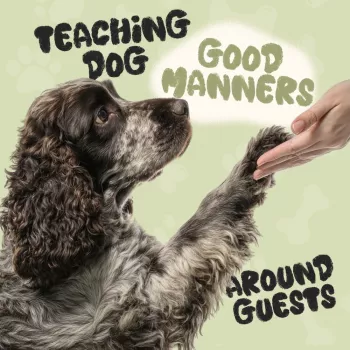
A calm greeting is a learnable skill. With a few consistent routines—before the door opens, at the doorway, and after guests sit down—dogs can trade jumping, barking, or grabbing for polite choices that keep everyone comfortable. The goal isn’t a “perfect” dog; it’s a predictable plan that sets your dog up to succeed.
Polite greetings are simple and measurable. Aim for four core behaviors: stay off people, keep teeth off clothing and hands, keep all four paws on the floor, and settle within a minute or two of the guest entering.
A default station (bed, mat, or crate) gives your dog a clear job while guests come in. Rather than guessing what to do with big feelings, your dog learns that “place” is the answer to door activity.
Progress comes from repetition, not willpower. Many short, predictable greetings—practice knocks, staged entries, quick resets—teach more than occasional “real-life” chaos. Coach guests to ignore your dog at first: no eye contact, no reaching, and no excited talk until your dog is calm.
Management prevents your dog from rehearsing the behavior you don’t want. Use a leash, a baby gate, or a closed door to give your dog a moment to decompress and to keep guests from accidentally reinforcing jumping.
Place high-value treats near the entryway so rewards are immediate. If the treats are in the pantry, the moment is gone—and the dog learns that rushing the door pays.
Reduce “trigger stacking” before company arrives. A short walk or sniff session 30–60 minutes beforehand can lower arousal and make the door routine easier. Pick a station spot away from the doorway to create space for guests to enter without your dog crowding them.
Start by introducing the mat or bed with zero pressure. Reward any step toward it, then reward standing on it, then sitting or lying down. The mat becomes a magnet because good things happen there.
Add a cue like “place.” Say the cue once, then lure or guide as needed and reward generously when your dog lands on the mat. Keep the tone calm and the rewards frequent.
Generalize before adding visitors. Practice from different rooms, then add mild distractions (you walking to the door, touching the doorknob, putting on shoes). If you’d like a structured, step-by-step resource to keep practice consistent, Teaching Dog Good Manners Around Guests can help you run short daily drills and gradually level up.
| Problem | What usually causes it | What to do next time |
|---|---|---|
| Jumping on guests | Greeting is more rewarding than sitting; guests accidentally reinforce by touching/talking | Ask guest to turn sideways and stay neutral; reward paws-on-floor; cue “place” before entry |
| Barking at the door | Alarm response + excitement; unclear job | Pair door sounds with treats on the mat; practice fake knocks; open the door only during quiet |
| Bolting out the door | Doorway has high value and no boundary training | Train a doorway “wait”; use leash/gate; reward waiting, then release through the door on cue |
| Mouthing hands/clothes | Overarousal, underexercised mouth needs, or playful greeting style | Offer a toy to carry; keep greetings brief; reinforce calm sits; end interaction if teeth appear |
| Nervous hiding or growling | Fear, lack of socialization, or past stress with strangers | Increase distance; let dog choose approach; pair guests with treat tossing; consult a professional if intense |
Prevent counter surfing and begging by feeding your dog away from the table and rewarding calm settling. A stable feeding setup can reduce clatter and sliding during busy gatherings; options like the Cartoon Owl Anti-Slip Pet Bowl – Large Capacity for Cats & Dogs or the Cartoon Cat & Dog Bowl with Strawberry Design make it easier to redirect your dog to a designated eating spot while guests handle food.
For fearful dogs, avoid forced greetings. Use barriers and treat tossing so the dog can choose distance, and consider muzzle conditioning for safety if needed. If barking escalates to lunging or snapping, work with a certified behavior professional for a tailored plan. For additional guidance on humane training and behavior, see the American Veterinary Society of Animal Behavior (AVSAB) position statements and the American Kennel Club training resources.
With consistent practice and preventing rehearsals, many dogs show big improvement in a few weeks, but the timeline depends on how often guests visit and whether everyone follows the same rules. Management (leash, gate, “place”) speeds progress by keeping jumping from paying off.
Yes—neutral body language reduces excitement and helps your dog make calmer choices. Once your dog has four paws on the floor (or is settled on the mat), guests can greet briefly and quietly, then pause again if the dog revs up.
Pair doorbell sounds with treats delivered on the mat, starting with low volume or a phone recording, and gradually increase realism as your dog stays calmer. Use “place,” add brief management with a leash or gate, and get professional help if barking escalates into aggressive behavior.









Leave a comment